My Edible Garden

I've been gardening for most of my life and have been a devoted fan of organic gardening the whole time. It just makes so much more sense to work in harmony with Mother Nature than to fight her. Besides which it is better for the planet and better for our bodies. Here you can see what I'm planting and harvesting, with gardening hints and resources thrown in for good measure.
Showing posts with label permaculture. Show all posts

Monday, January 23, 2017

A Little of This & That

Pinal Peak Jan 22, 2017
We had a pretty sunset yesterday evening; I was going down the driveway just in time to see the sun highlight the mountains. A good bit of snow up there.

rainfall week ending Jan 22, 2017
In the past week we've had 2.1 inches of rain. We sure need the moisture but I wish it would spread things out a bit. It's raining again already. Can't we save some for June and July?

Leek Seedlings
I haven't grown leeks before but I grow garlic and onions so shouldn't be any real difference. The main difference is planting the leeks deeply and hilling earth up around them when they get bigger. That is what makes a long white stem.

Parsley seedlings
In spite of garden books predicting it taking a long time, my parsley seedlings are germinating, only about 10 days after planting. I think I saw a speck of green in the sage tray too.

Scarlet Kale seedlings
Can't wait to see what the Scarlet Kale is like. This makes 4 varieties of kale this year!

new layer
I don't think the new girl laying quite gets the idea of what the box is for.....

I bought the book Gaia's Garden a couple of years ago. This is a great introduction into the concepts of Permaculture. There are some great projects and ideas to help you get started with becoming more self sufficient, resilient and sustainable around your home and in your garden. If you don't know, Permaculture is described as a design science. Things are designed so that the wastes of one system feed another. Remember in Nature there is no such thing as garbage. Only humans create garbage. Permaculture design principles can be used to design any system, from an urban homestead to a city to a large company. When thinking about something new around my place I ask myself if it fits into the Ethics of Permaculture: Care of the Earth, Care of the People, Share the Surplus
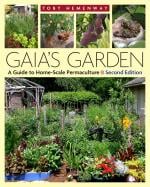

Gaia's Garden, Second Edition

from: Chelsea Green Publishing

Wednesday, August 29, 2012

Permaculture


Permaculture is a method of designing (pretty much the principles can be applied to designing anything) where we look for how energy flows in and out. On our homesteads major energy flows include sunlight, water, wind, mulch and manure materials as well as animals people. Gaia's Garden is a great beginner's book about designing permaculture gardens to help you get started. One of the great ideas I like from permaculture is to put your chicken coop and other animal shelters at the top of a slope and your garden at the bottom. That way the manure and bedding will work it's way down the hill to land where it's most needed, in the garden. Permaculture also teaches us that there is no waste in nature. Leftover/waste material from one operation becomes the fuel for the next. Personally I'm working on a  zero waste household. I have a long ways to go, but it gets better all the time. (Look in your trash can; most of what you throw away every day is food packaging. If you are growing your own, there isn't any packaging to throw away!)

For loads of free e-books about a variety of sustainable living topics, from building healthy soils, caring for animals, organic farming, health and many others, visit the Permaculture Media Blog's listing of free books.


Another great resource is Journey to Forever's Small Farm Library. This listing contains many agricultural classics on the importance of soil and health.

We really don't need to spend a lot of money to make our homes actually pay us to live there. A garden of fresh fruits and vegetables pays big dividends in providing us health promoting food at little expense. A few small animals such as rabbits, chickens and ducks can provide our meat and eggs. They also help recycle garden and food waste to help increase the fertility of our soil so we can grow more food. This means less waste goes to the land fill and less things we need to bring in from the outside. This is in direct contrast to Big Ag which uses up large amounts of oil & natural gas for machinery as well as fertilizers and for packaging and transportation.

Wednesday, August 22, 2012

Permaculture Growing

Permaculture bed June 23, 2012
Permaculture is  a concept that I have just been learning about the last three years or so. Taken altogether permaculture is actually more a design method rather than a gardening technique. Permaculture aims to provide for people while also providing and caring for nature. The principles can be applied to anything you are doing, from designing a landscape, a community, a home or even a business.

One of the things that permaculture stresses is to make everything multi-functional, called 'stacking functions'. One example would be to build a trellis over a deck or patio for shade and grow a grape vine on it to provide shade and fruit in summer, as well as bird and insect habitat, while still allowing warm sunshine in during winter when it is welcome.

Another example is to plant a bed with a variety of vegetables, annuals, bi-annuals and even perennials  all mixed together. As you harvest the fastest growers you leave room for the other plants to mature.

I experimented with the concept this summer. This small bed in my front yard gets a  far amount of afternoon shade, helping to keep it a little cooler than more open areas. In mid-May I planted salad bowl lettuce and some Golden Bantam corn. It was still just cool enough to get the lettuce to sprout. The lettuce acted as a kind of ground cover, helping shade the soil and keep moisture in and gave me several cuts of leaves before it got too hot.

As the lettuce disappeared in the heat I planted some white scallop summer squash. I also allowed a few edible weeds to grow. (I did take out that sunflower in the first picture; this type has tiny seeds which the gold finches love, but it produces a huge amount of pollen that really causes my allergies to act up).

Permaculture bed Aug 22, 2012
Here is the bed today, the corn has been harvested and the squash is slowing down. There are still a lot of red root pigweeds in here that I harvest for the rabbits and chickens. Pigweed is a type of wild amaranth and has a good protein level, besides the animals love it.

This bed is not very big, about 34" wide and 8' long, making it less than 24 square feet of growing space. Also it is a fairly new bed so the fertility of the soil is not up to full speed yet.

Despite these problems it has been fairly productive, so far this year it has yielded about 5 pounds of lettuce, 3 pounds of squash (with more on the vine) and 10 ears of sweet corn. In addition it has contributed several buckets of amaranth and lambs quarters to feed the rabbits and chickens. I'll be experimenting with this concept some more next year and in the meantime I'll be working to boost the soil's fertility and organic matter.

To learn more about permaculture, it's principles and ideals and how to apply it to your garden I highly recommend Gaia's Garden by Toby Hemenway


Tuesday, March 6, 2012

Permaculture & Chickens

Permaculture is not really just about gardening, but is a design parameter that can be used to design almost anything, including towns, businesses and even social areas or events. Since I got paid for some of my online articles and things I had a bit extra and decided to buy some new books. First was Gaia's Garden by Toby Hemenway. The other one I picked was Harvey Ussery's
Small Scale Poultry Flock. I've been browsing Harvey's blog and really liked what I saw.                                                          
                                                                sorry for the odd look of this post; I can't figure out how to make the Amazon iframes go where I'd like them too and put the text next to the box like I can with photos. But I think you get the point. My books should arrive by next Monday, I'll probably do a review when I'm done with them.