It is always a good thing to keep records of your garden from year to year. I haven't been so good the last couple of years, but in the past I have filled large binders full of plot plans, crop rotations, old seed packets, photographs, plant lists, planting times and harvest records. All of these bits of information really help me plan what, where, when and even how to plant next year.
I designed this binder to be completely customizable. You can change any of the text and pictures to personalize it to your garden. Add in your own page protectors, photo sheets and journal pages and you'll have a record of this year's garden for years to come.
I've finished up the last bag of cement that I had so I'm done with that until I come home from vacation in September. I still have quite a ways to go on this wall and when I finish this area I have to start on the other side of the crossing. That storm July 4th caused a lot of erosion on the other side. Perhaps I'll get a picture of it tomorrow.
My Edible Garden
I've been gardening for most of my life and have been a devoted fan of organic gardening the whole time. It just makes so much more sense to work in harmony with Mother Nature than to fight her. Besides which it is better for the planet and better for our bodies. Here you can see what I'm planting and harvesting, with gardening hints and resources thrown in for good measure.
Saturday, August 13, 2011
Sunday, August 7, 2011
Beets, Carrots, Rocks
| Beet Seedlings, Aug 7, 2011 |
| carrot seedlings Aug 7, 2011 |
More work on the rock walls around the culvert in the creek. I have about enough cement left to make one more batch and then I'm done until I come home from vacation in September.
I tried to do that last batch this morning but it just got too darn hot. Now there are thunder grumbles so I suppose I should just go ahead and clean up and do something else for the afternoon.
| rock walls from above |
| Walls from above and to the side |
| walls and culverts in the creek |
Thursday, August 4, 2011
Getting The Most from Gardening on a Budget: Organic Gardening
This is a really awesome article about gardening on the cheap. Loads of great ideas and how to for everyone.
Getting The Most from Gardening on a Budget: Organic Gardening
Wednesday, August 3, 2011
Hard Rock Labor
I've been working on getting the retaining walls built around the culverts the last couple of days. Here's where I left off this morning.
The warm weather and light showers have really been helping the garden grow. Here are the beans and the potatoes.
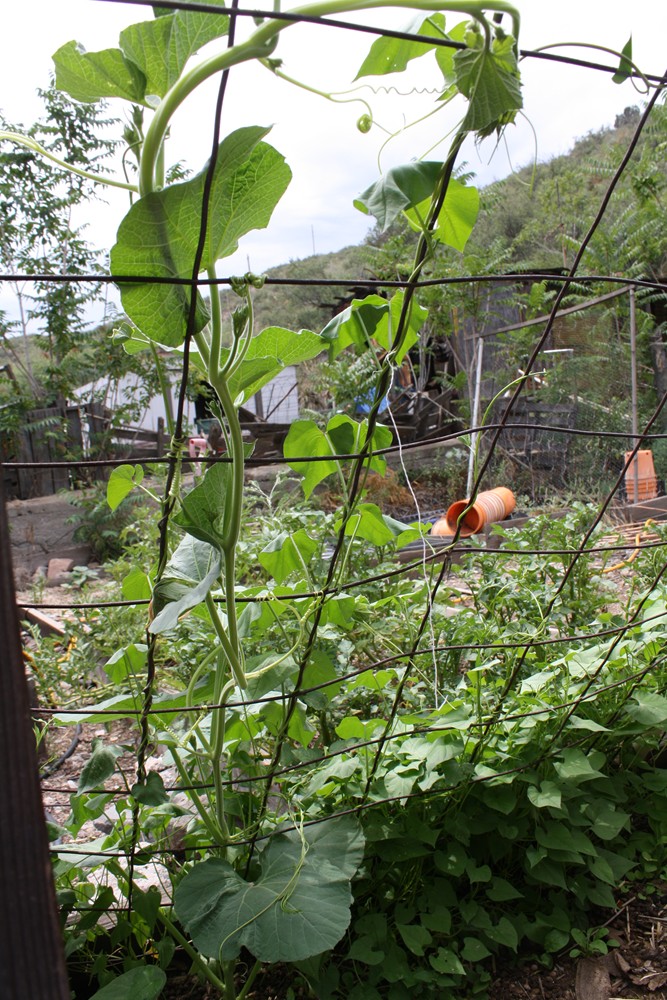
This gourd vine has been growing almost 2 inches a day! At the base of the trellis are Heavenly Blue Morning glories. I just love them. By the time I come home from vacation they may be in bloom.

If you haven't tried Botanical Interests seeds I've bought them off the rack at retail stores many times. Now I've discovered there is even more variety on their website. Great seeds and their packets are a wonder, full of information on the outside AND the inside!
The warm weather and light showers have really been helping the garden grow. Here are the beans and the potatoes.
This gourd vine has been growing almost 2 inches a day! At the base of the trellis are Heavenly Blue Morning glories. I just love them. By the time I come home from vacation they may be in bloom.
If you haven't tried Botanical Interests seeds I've bought them off the rack at retail stores many times. Now I've discovered there is even more variety on their website. Great seeds and their packets are a wonder, full of information on the outside AND the inside!
Monday, August 1, 2011
Carrots, Parsnips, Beets & Fennel
Last night we got a nice little rain, about .6" It's trying to rain again this evening but I don't think it's going to make it, the clouds are moving off in the other direction.
I decided I would plant just a little bit more before I leave for vacation. If I'm lucky things will survive and I'll be a month ahead than if I wait until I come home.
When I was cleaning up the silt and leaf mold that washed down onto the patio and sidewalk I dumped it onto one of my garden beds. I decided it might be good for my root crops. I added some potash and some seaweed meal and loosened everything up.
This evening I planted a few fennel seeds, some Danvers carrots, parsnips and three different kinds of beets. Cylindra is a carrot shaped beet that is easy to slice for canning. In 2004 I ordered a mix of Heritage beets from Bountiful Gardens. There was a large white beet in the mix from which I saved seeds, so I planted a row of them. I had some of the original Heritage mix left so I planted those too.
Here in the desert since water conservation is so important, I plant at the bottom of the furrow. That directs any rainfall straight to the plant roots. After I watered the seeds I covered the bed with my trusty old door and window screens to keep out the pesky quail and the neighbors cat.
When it looked like it wouldn't rain again today, I mixed up the rest of the open bag of cement and worked on the walls down in the creek bottom again. I worked on it a couple of hours early yesterday morning, too.
I've actually moved quit a bit of sand and rock the past couple of days. My mortar joints aren't very pretty but I think they will do the job. This wall follows the creek bank and the cement is mostly in the front face, with loose rock for back fill. Every once in awhile I lay a bigger rock that goes back farther to help tie things together.
All my life I have wanted to build a stone house. I still do. In fact working on this wall reminds me of how much fun I have doing this sort of work. And I'll certainly get in some practice in making nice mortar joints with this project!
Of course you can always use slip forms. This is where you use shallow forms, fill them with stone and cement and when the cement sets up you move the forms up the wall and do it again. Once the wall is completed you go back over the face of it and 'point' it, that is using a fine mortar mix and a small trowel you smooth out the joints and fill in any holes or gaps.
Or what these folks did; they just built a frame house and built stone walls on the outside of the frame. They covered the interior walls with sheet rock and it gave them a space to run their plumbing and electric lines.
People have been building with stone for thousands of years. Here in the southwest the Native Americans used rocks and mud, many of their pueblos are still standing 200-500 years later.
The same in Italy. I saw farm houses there with walls 18-24 inches thick, built by the farmers themselves. Rocks with at least one flat side are set on each side of the wall and the space in between is filled with mud and rubble. This is also a common building technique in many other countries, from Irish cottages to great English Castles.
I decided I would plant just a little bit more before I leave for vacation. If I'm lucky things will survive and I'll be a month ahead than if I wait until I come home.
When I was cleaning up the silt and leaf mold that washed down onto the patio and sidewalk I dumped it onto one of my garden beds. I decided it might be good for my root crops. I added some potash and some seaweed meal and loosened everything up.
This evening I planted a few fennel seeds, some Danvers carrots, parsnips and three different kinds of beets. Cylindra is a carrot shaped beet that is easy to slice for canning. In 2004 I ordered a mix of Heritage beets from Bountiful Gardens. There was a large white beet in the mix from which I saved seeds, so I planted a row of them. I had some of the original Heritage mix left so I planted those too.
Here in the desert since water conservation is so important, I plant at the bottom of the furrow. That directs any rainfall straight to the plant roots. After I watered the seeds I covered the bed with my trusty old door and window screens to keep out the pesky quail and the neighbors cat.
When it looked like it wouldn't rain again today, I mixed up the rest of the open bag of cement and worked on the walls down in the creek bottom again. I worked on it a couple of hours early yesterday morning, too.
I've actually moved quit a bit of sand and rock the past couple of days. My mortar joints aren't very pretty but I think they will do the job. This wall follows the creek bank and the cement is mostly in the front face, with loose rock for back fill. Every once in awhile I lay a bigger rock that goes back farther to help tie things together.
All my life I have wanted to build a stone house. I still do. In fact working on this wall reminds me of how much fun I have doing this sort of work. And I'll certainly get in some practice in making nice mortar joints with this project!
Of course you can always use slip forms. This is where you use shallow forms, fill them with stone and cement and when the cement sets up you move the forms up the wall and do it again. Once the wall is completed you go back over the face of it and 'point' it, that is using a fine mortar mix and a small trowel you smooth out the joints and fill in any holes or gaps.
Or what these folks did; they just built a frame house and built stone walls on the outside of the frame. They covered the interior walls with sheet rock and it gave them a space to run their plumbing and electric lines.
People have been building with stone for thousands of years. Here in the southwest the Native Americans used rocks and mud, many of their pueblos are still standing 200-500 years later.
The same in Italy. I saw farm houses there with walls 18-24 inches thick, built by the farmers themselves. Rocks with at least one flat side are set on each side of the wall and the space in between is filled with mud and rubble. This is also a common building technique in many other countries, from Irish cottages to great English Castles.
Sunday, July 31, 2011
Pea Planting
| Dwarf Grey Sugar Pea |
I wrote an article comparing them for Associated Content. I could probably plant peas now, but I'm not going to since I will be leaving soon on my vacation. The weather should be a lot cooler when I get home, so I will plant peas in mid-September instead.
Here are a few photos of the peas from 2009. Enjoy. (Unfortunately I didn't label the photos with the variety, and I don't remember now what some of them looked like!)
| Bleushokker, a soup pea |
| I'm not sure which one this is, either Sweet Magnolia or Bleushokker |
| Maxi Golt, a shelling pea |
Labels:
Bleushokker,
bleushokker peas,
desert gardening,
food,
food crops,
food gardening,
food security,
grow your own food,
grow food,
organic gardening,
peas
Sunday, July 24, 2011
Not Gardening OR Edible!
| culverts in the creek, before |
I have a creek, really a dry wash that fills with water during rainstorms, that runs through my property. Since my house sits in the bottom of the canyon, with steep hills on each side there is not much flat space for things like gardens, pasture, animal corrals or barns.
My son and some friends installed these culverts so we could drive across to the other side of the creek to a nice size flat area. We almost lost them in the storm July 4th, but they are hanging in there.
| culverts in the creek, after |
Yesterday my son brought me the cement mixer from my mom's place and this morning I went and bought some ready mix. I managed to haul and mix three 80 pound bags before I needed to quit. I dug a little trench in front of the culverts and pulled some of the rocks down that are on each side of them. Then poured a little concrete apron along in front of them, to prevent water from washing under them and taking the whole crossing out. I poured a little cement on the sides of the culverts and reset some of the rocks.
It's going to take a lot of cement and rocks to build up around this area to prevent wash outs. Hot, heavy and exhausting work. What I got done today took about 2 hours, what with having to deal with the cranky mixer. BTW dear son if you are reading this, can we rig a safety switch on that motor? I hate having to plug and unplug it to turn it off and on, especially when my gloves are wet.
Next I'll be working on building up the walls along the creek sides to prevent more soil washing out. I do love building walls and working with rocks. It is heavy tiring work, but it is also fun and satisfying, yeah I know, I'm weird.
John Vivian has written a very good manual about building stone walls, mostly about laying them up without mortar or cement and without using forms.
Mike Lawerence will show you how to use brick or stone to build walls, steps, patios and paths. A handy reference book for folks new to the craft, with lovely color photographs of different garden features.
Of course people have been building with stone for as long as they have been building their own shelter. Perhaps you'd like to have a go at building your own stone house. I intend to do so in the future.
Wednesday, July 20, 2011
| bean plants running July 20, 2011 |
| Potato Plants July 20, 2011 |
| Rain water tank |
Another project I need to get on with is getting the whole house guttered and getting more water tanks. I was talking to someone about rain water catchment awhile back and they didn't think it would be worth their while to do it at their house. I pointed out that if it rains 1", then you will collect a little over half a gallon of water from every square foot of roof area. So if you have 1,000 square feet of roof area, then for every one inch of rainfall, you will collect over 500 gallons of water.
My rain tank is an old fertigator tank given to me by a friend when they were moving out of state. There are many types and styles of tanks available now. My advice is to buy as many and as big as possible.Of course you can start small like I am and then buy more tanks as money allows. I've collected a few links for you if you are interested in rain water harvesting.
Monday, July 11, 2011
Beans & Potatoes!
| Hopi Purple Pod Beans |
The potatoes are doing great. The ones on the left are bakers and the ones on the right are the red and purple ones. I have used the silt and oak leaves that washed down onto the sidewalk and patio to mulch them with.
| potatoes growing in mulch |
The herbs in pots on the front steps are doing well, several pots of catmint, a variegated oregano, lemon basil, regular basil, lemon thyme and chives. The catmint is doing so well that my garden fairy is nearly hidden. Can you find her? Remember you can click on the pictures to see them larger.
| Garden Fairy |
Here they act as herbaceous perennials, dieing down each fall and coming back from their roots in early summer.
Once they have grown a full season they are very difficult to transplant, since you can't seem to get all the root. So start some seedlings in pots and move them while they are small to their permanent home. If you don't have any neighbors to beg or trade seeds with, you can order some online.
Remember the little sunflower seedlings? Only a couple of them made it, between my crazy work schedule where I wasn't home to water in time before they wilted and what ever bugs & such were munching on the. But those two are growing steadily.
Tuesday, July 5, 2011
RAIN FINALLY!
Well I was at work when it happened. A huge thunderstorm rolled in and in less than an hour dumped 1.4 inches of rain at my place. Which is wonderful. Except it came so hard and fast a lot of it just ran off the hillsides, down the back sidewalk and right into my back porch and kitchen. It is going to take a bit to get it all cleaned. up.
This is the kind of rain gauge I have. Inexpensive and does the job. It has a gauge that you can stick in the ground and check how much water your sprinkler system is actually putting out or put the big tube into the short one and see how many inches of rain you received.
When you are siting your rain gauge keep it away from buildings, trees, bushes, anything that would hang over it and drip extra water into it. You want it to be in a wide open area to get a true reading.
This is looking into my kitchen from my living room. I had just gotten home from work and was on my way to the kitchen to get a drink.... Mud and water; my floor is actually supposed to be blue.
And here's my back porch with a couple of inches of wet mud in it. I was saying things I cannot repeat here. I don't think anything that would be majorly ruined by the water was that close to the floor, unless it's deeper under the washing machine.
But I won't even bother starting to clean it up yet. Not only do I have to work a lot this week, the first thing I have to do is go up on the hill and clean out the drainage ditch. I don't think I've gone up there in a couple of years and most of the water and mud ran off the hill from up there.
But I can't find my shovel. I'm thinking I left it down in the creek when I was working down there a couple of weeks ago....which means if it isn't buried by now it's miles downstream.
This is the kind of rain gauge I have. Inexpensive and does the job. It has a gauge that you can stick in the ground and check how much water your sprinkler system is actually putting out or put the big tube into the short one and see how many inches of rain you received.
When you are siting your rain gauge keep it away from buildings, trees, bushes, anything that would hang over it and drip extra water into it. You want it to be in a wide open area to get a true reading.
This is looking into my kitchen from my living room. I had just gotten home from work and was on my way to the kitchen to get a drink.... Mud and water; my floor is actually supposed to be blue.
And here's my back porch with a couple of inches of wet mud in it. I was saying things I cannot repeat here. I don't think anything that would be majorly ruined by the water was that close to the floor, unless it's deeper under the washing machine.
But I won't even bother starting to clean it up yet. Not only do I have to work a lot this week, the first thing I have to do is go up on the hill and clean out the drainage ditch. I don't think I've gone up there in a couple of years and most of the water and mud ran off the hill from up there.
But I can't find my shovel. I'm thinking I left it down in the creek when I was working down there a couple of weeks ago....which means if it isn't buried by now it's miles downstream.
Subscribe to:
Posts (Atom)